


About What to Expect My Approach Fees & Appointments Links Home
My work as a psychotherapist is informed primarily by Existential and Buddhist psychologies. What appeals to me about these theories is that they focus on the human experience of being in the world and the role of the mind in creating that experience. While the origins of these psychologies are divided by some 2500 years, there are many similarities that make them complementary. Both perspectives have been useful to me personally, contributing to how I understand my experience and navigate the ebb and flow of life. Professionally, they influence both how I work with people and what I focus on in our work together.
Nature of Existence
A central tenet of both Buddhism and Existentialism is that the only certainty in life is change. According to Buddhist teachings, we try to insulate ourselves from this impermanence by making our existence, our very sense of self, somehow constant. One of the defining qualities of human experience from an Existential perspective is that we live knowing we will die. The many endings that occur during a lifetime – whether involving changes in our relationships, our work, or our health — can leave us feeling at a loss, without a sense of meaning or structure.
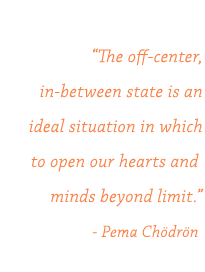
Often this is a time when people seek therapy. In the midst of changes in our lives, we find ourselves in an in-between place, needing to let go of the way things have been and move into the present. But the present can be characterized by ambiguity and uncertainty, and in reaction we may feel confused and frightened. Like the trapeze artist who must let go of one swing in order to grab hold of the next, we find ourselves in mid-air, without the support of ground below or something to hang onto above.
Human Suffering
A core Buddhist teaching is that suffering comes not simply from the inevitable uncertainties of life, but our reaction to it. Instead of accepting the reality of impermanence, we either become attached to or deny the way things are, wishing them otherwise. We become identified with our habitual ways of making sense of our world and acting in it, creating something that is dependable and controllable. Unfortunately, such attempts to protect oneself against suffering actually fuel it. The identity we have created becomes increasingly rigid, cutting us off from the direct experience of what is, and in so doing, limiting our capacity to adapt and grow in response to changing circumstances.
Existentialists also believe that suffering comes from resistance to what is, in the form of anxiety, a fear associated with the state of not knowing. Anxiety can arise when we encounter certain fundamental aspects of human existence around which many of us struggle, typically experienced as a tension between opposites: life and death; freedom and responsibility; isolation and connection; meaning and meaninglessness. For example, while we do not have control over all life circumstances, we do have the freedom to choose how we make sense of and respond to such circumstances. But these choices come with responsibility for our experience.
Anxiety need not be a problem. If we can live in the midst of the inevitable tension, accepting and engaging these seeming contradictions, anxiety can prompt us to take action in response to changing circumstances. More often, however, we react against it, attempting to protect ourselves from what feels threatening by denying it. When we do this, anxiety can leave us feeling immobilized and stuck.
Path of Mindfulness
Although our natural inclination is to distance or buffer ourselves from that which troubles us, according to both Existential and Buddhist psychologies, the path of healing is into and through rather than around our experience of suffering. Mindfulness, a central practice of Buddhist meditation, provides the vehicle for this process.
Jon Kabat-Zinn says that “mindfulness means paying attention in a particular way: on purpose, in the present moment, and non-judgmentally.” I like the simplicity of that definition, which captures the essence of my approach to psychotherapy. Gently and gradually, we work together to expand awareness and understanding of your present experience and to cultivate compassion for the self that is suffering. For many of us, the habitual and harsh judgments we make about ourselves serve only to increase and sustain our suffering. Compassion, then, provides a necessary antidote, essential if we are to truly open to the present moment and our experience of it.
Mindfulness is more than a therapeutic technique, however. It is a way of being in relationship to what we encounter in our day-to-day lives that can leave us more open and less reactive to whatever arises in the moment, joy or suffering, boredom or engagement. It is a capacity that — along with compassion for self – may first be explored and cultivated with the support of therapy, but increasingly practiced in one’s day-to-day life. The practice of mindfulness can provide a greater sense of possibilities in the moment, and with it, the sense of freedom that comes with choice.
Lisa Weinberg, MA, LMHC Psychotherapy
Downtown Seattle and South Whidbey Island
(206) 898-0515 | lisa@lisaweinberg.net
Note: Information transmitted over email may not be secure.
©2021 by Lisa Weinberg. All rights reserved. Material may not be reproduced or reprinted without the explicit, written permission of Lisa Weinberg.